Safewords, traffic lights and consent: how kink stays safe
Updated October 12, 2026 · 6-minute read · 7 sections
Ask around what a safeword is for and most people say "to make it stop". That is right, but it misses the point I stress in every beginner workshop: a safeword is there for the moment someone cannot or does not want to explain themselves, and the whole system only works if everyone trusts it will be honoured without an argument.
Below is the setup I teach before any scene happens: what consent actually means, how to pick a safeword that survives real play, the traffic-light words, and the limits conversation that comes first. If you just took the BDSM test and want to use the result with someone, start here.
Consent is informed, voluntary and revocable
The NCSF Statement on Consent defines consent as an informed, voluntary agreement to a particular activity or relationship (NCSF, Consent Counts). Three words carry the weight:
- Informed: you both know what is planned, what it can feel like and what can go wrong.
- Voluntary: pressure, threats and deceit mean there was no consent, however the word "yes" was produced.
- Revocable: consent can be withdrawn at any time, including halfway through something you asked for. A yes last week is not a yes tonight.
Drink and drugs undermine the first two. My rule is simple: no new activities and no negotiation when either of you has been drinking. Do the planning sober and keep the scene itself within what you already agreed.
A test result is not consent either. A high score tells you what appeals, not what a particular person agrees to with you on a particular night.
How to choose a safeword
A safeword is a pre-agreed word that stops or pauses play, no questions asked in the moment. Pick it together, in advance, and say it out loud once so it is not a stranger on the night. The NCSF statement adds the point that matters most: ignoring an agreed safeword or safe sign violates consent.
| Good safeword | Poor safeword |
|---|---|
| A word that cannot be part of the play, such as "lighthouse" or "orchard" | "No" or "stop" when saying them is part of the scene |
| Easy to say and easy to hear when your voice is shaky | A long or foreign word you might forget under stress |
| Agreed by both people, and practised once | One person's private choice that the other half remembers |
| Used only for its job, with the same meaning every time | A pet name or a joke word you use all the time |
The classic mistake is a scene where saying "no" is part of the resistance, and "no" is also the safeword. Nobody can tell which is which. Keep the real word out of the story.
Some people also want two words: one to stop everything and one to slow down. That is where the traffic lights come in.
Traffic lights and signals when speech is limited
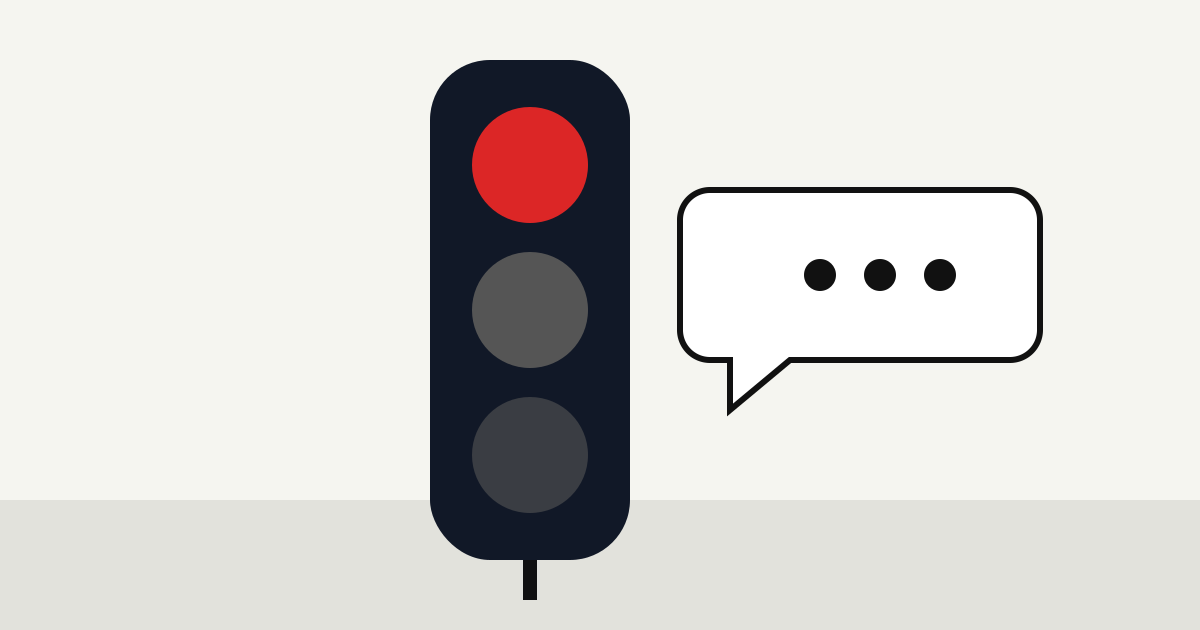
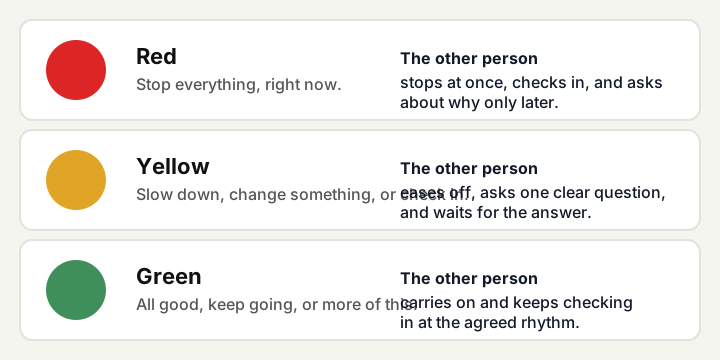
Red, yellow and green are the quickest check-in vocabulary I know. Anyone can use them, they need no explanation, and they work well at a whisper.
Speech is not always available. If someone's voice is limited, agree a non-verbal signal beforehand, for example dropping a small object they are holding, or three taps on the arm or the floor. Then actually test it before the scene: hand over the object, drop it, and see that both of you react. A signal nobody has practised is a hope, not a plan.
I do not do, and do not teach, anything that removes the other person's ability to signal. Practices that restrict breathing, or that put weight on a body in ways that need expert knowledge, carry serious risk and sit outside what this site covers. If you want to learn anything of that kind, do it in person with experienced, reputable educators, not from a web page.
SSC and RACK: two ways of framing safety
| SSC | RACK | |
|---|---|---|
| Stands for | Safe, sane, consensual | Risk-aware consensual kink |
| Core idea | Only do things that are safe, with a clear head and agreement | Nothing is risk-free, so choose with open eyes and share the risks |
| Strength | Simple, a good default for beginners | Honest about accidents and misjudgement |
| Weak spot | "Safe" and "sane" are judgement calls | Can be used as an excuse for sloppiness |
I use both. SSC is my baseline, and RACK is the honest admission behind it. The NCSF statement names the same risks: limits that were misunderstood, accidents, and intensity that carries people away. That is exactly why negotiation and check-ins exist.
Hard limits, soft limits and the list
A hard limit is a never: not tonight, not later, not with persuasion. A soft limit is a maybe with conditions, such as "only with a lot of trust" or "only briefly". Both are legitimate, and neither needs a reason. A yes/maybe/no list is the easiest way to set them out: each person marks what they want, might want and do not want (Scarleteen's yes/no/maybe inventory is a well-known example). The conversation itself is covered in how to talk to a partner about kink.
A negotiation you can run in twenty minutes
- Talk outside the bedroom and outside the moment, sober and unhurried.
- Go through a yes/maybe/no list and mark hard limits first.
- Agree the safeword, the traffic-light words and a non-verbal signal. Say them out loud.
- Agree how often you will check in during the scene, and what a check-in sounds like.
- Agree aftercare: what each of you tends to need afterwards, and when you will check in the next day (see aftercare and sub drop).
- Start small with one activity, and review it together before adding another.
When a safeword is ignored
If a safeword or signal is ignored, consent was violated. It does not matter whether it was meant, whether the person was "in the zone" or whether they apologise warmly. I stop playing with anyone who does it, and I tell my friends to do the same. A good partner who made a real mistake will accept that and will not ask you to carry the repair. Laws on consent and injury differ by country; this is general information, not legal advice. If you were hurt, talk to someone you trust or a service where you live.
For what each score on the test means before you ever get to this point, see BDSM test results explained.
FAQ
How do I choose a safeword?
Choose a word that cannot be part of the play, that is easy to say and hear, and that both of you agree on and say out loud once beforehand. Avoid "no" or "stop" when resistance is part of the scene.
What is the traffic light system?
Red means stop everything now, yellow means slow down or check in, and green means all good. It is a quick shared vocabulary for checking in during a scene.
What is the difference between SSC and RACK?
SSC means safe, sane and consensual. RACK means risk-aware consensual kink, which accepts that risk can never be removed and asks people to choose with open eyes. Many people use both.
What if I cannot speak during a scene?
Agree a non-verbal signal beforehand, such as dropping a small object or three taps, and test it before you start. Do not do anything that takes away the other person's ability to signal.
Can consent be withdrawn after it was given?
Yes. Consent can be withdrawn at any time, including in the middle of an activity you asked for. Ignoring an agreed safeword or signal means consent has been violated.