How to talk to a partner about kink: the yes, maybe, no conversation
Updated October 12, 2026 · 6-minute read · 7 sections
The worst place to bring up kink is the bedroom, at the exact moment you want it. The person you are asking has no time to think, feels put on the spot and will usually say no to protect themselves. The conversation goes much better when nothing is about to happen.
These are the openers, the timing, the yes/maybe/no routine and the follow-up I recommend to couples who found the same BDSM test trend and want to try something. It stays specific to kink. For general relationship communication, other advice will serve you better.
Choose the moment before the words
Most failed conversations fail on timing, not wording.
| Works | Does not work |
|---|---|
| A walk or a drive, where you sit side by side and nobody has to hold eye contact | In bed, mid-scene, or when sex is the next thing on the schedule |
| Sober, rested and with an hour to spare | After drinks, late at night or right before work |
| A calm week, with the question framed as curiosity | In the middle of an argument, as a point to win |
| In private, with phones away | In front of others, or by text while one of you is busy |
Say at the start how long you need, and give the other person a way out: "Can I tell you something I have been curious about? You can say not now."
Opening lines that do not corner anyone
A good opener makes it about curiosity, not about a request. A few that have worked for people I know:
- "I took a quiz and some of the results surprised me. Would you like to see them?"
- "There is something I have been curious about, and I would rather tell you than keep it to myself. Nothing has to happen."
- "I read about how couples make a list of what they would and would not try. Want to do one together, just for fun?"
Leave out: "I need", "you never", "everyone does" and any version of "if you loved me". Pressure is the opposite of what you are trying to build.
Use the test result as a neutral third party
A result gives you something to point at that is not you. "My top interests came out as sensualist and role-player" lands more gently than "I want you to be in charge". On this site's BDSM test, you can each take the test on your own device and compare through a short code in the link. The code stays in your browser and is never sent anywhere, so there is nothing for either of you to worry about.
The comparison marks each pair as a good fit, talk first, or low for both. Read "talk first" as exactly that: one person is keen, the other is not, so start with a conversation. A match is a conversation starter, never consent. What the scores mean is explained in BDSM test results explained.
Run a yes, maybe, no list together
A yes/maybe/no list is an old tool from sex educators and the kink community: each person marks what they want, might want and do not want (Scarleteen's inventory is a widely used example). You can use it alone as self-reflection or together with a partner. The test on this site builds one after your result, with 24 activities in groups. Nothing is stored; you can copy or print it.
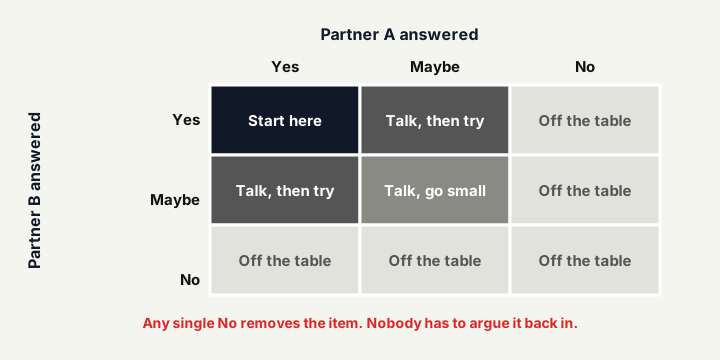
- Fill it in separately, so neither of you is influenced by the other's face.
- Swap lists, or sit side by side and read them together.
- Start with the items where you both said yes. They are the safe place to begin.
- Move to yes and maybe, and ask what would make the maybe a yes.
- Skip every item where either of you said no. No explanation is needed.
How to take a no or a maybe
You will hear both, and what you do next decides whether the conversation continues.
| You hear | Say | Avoid |
|---|---|---|
| "No" | "Thank you for telling me. It is off the list." | Asking again next week, bargaining, sulking, or "just try it once" |
| "Maybe" | "What would have to be true for that to feel okay?" | Treating it as a yes with a delay |
| "I need to think" | "Sure. Tell me when you are ready, or tell me you would rather not." | Checking in daily |
| Silence | "We can stop here. I am glad we talked." | Filling the quiet with more reasons |
A no about one activity is not a no to you. I say that out loud when it matters: I am not rejecting you, I am saying no to this one thing. A maybe usually has conditions: a certain mood, a short time, a particular setup. Ask for them once and respect the answer.
Start small and debrief
When you do try something, pick one activity from the yes-yes cell, and agree before you start:
- how long it will last,
- the safeword, the traffic-light words and a non-verbal signal (see safewords and consent),
- what aftercare looks like (see aftercare and sub drop).
The next day, ask three questions: what did you like, what would you change, and is there anything you want off the list now? Be ready to hear "nothing, I would rather not repeat that". That answer is useful, not a failure.
When your interests do not overlap
It happens, and it is fine. A few options:
- Look at the shared scales. Sensualist, role-player and experimentalist are the usual meeting points, and most people can find something there.
- Keep a fantasy a fantasy. Plenty of interests are enjoyed in the mind and never need acting out.
- Be honest about a deal-breaker. If one of you has a need the other cannot meet, say so plainly. Nobody should bend a no, and nobody should hide a need until it turns into resentment.
- Consider outside help. A couples therapist who is open about kink can help when the gap is hurting the relationship. That is general information, not a prescription.
The aim is not to get your partner to want what you want. It is to know where you stand with each other, so that whatever you do next is something both of you chose.
FAQ
When is the best time to talk to a partner about kink?
Outside the bedroom, when you are both sober, rested and unhurried, and not in the middle of an argument. A walk or a drive works well because you sit side by side.
How do I start the conversation?
Open with curiosity, not a demand: say you took a quiz, or that there is something you have been curious about and nothing has to happen. Let the other person say not now.
What is a yes/maybe/no list?
A list where each person marks what they want, might want and do not want. It can be used alone or together. Compare lists, start with shared yes items, and drop anything either of you marked no.
What if my partner says no?
Thank them, take the item off the list and do not bargain. A no to one activity is not a rejection of you. Raise it again only if they bring it back themselves.
What if our results do not match?
Look at the shared scales such as sensualist, role-player and experimentalist, keep some interests as fantasy, and be honest about any deal-breaker. A kink-aware couples therapist can help if the gap hurts.