Aftercare and sub drop: what follows a scene and how to plan
Updated October 12, 2026 · 5-minute read · 7 sections
The scene ended an hour ago, everything went to plan, and you suddenly feel flat, teary or oddly irritable. Nothing went wrong. That dip is common enough that kink educators have names for it, and a good chunk of what keeps it small is decided before the scene starts.
Below is what aftercare is, a kit that takes five minutes to put together, what sub drop and top drop look like, and how to write all of it into the plan you make from your BDSM test results and your limits list.
What aftercare is
Aftercare is the physical and emotional care that follows a scene. It is for both people, not only the one who received the intense part. The person who led can feel just as wobbly, often with worry about whether they went too far. It is not reserved for heavy scenes either: a gentle evening of teasing and role-play deserves a soft landing, too.
I describe it as the bridge back to ordinary life. During a scene you are both in an unusual state: heightened attention, adrenaline, trust turned up. Aftercare lets that settle gradually instead of switching off at the end of the last activity.
A kit you can put together in five minutes
Set it within reach before you begin, because nobody wants to hunt for a blanket afterwards.
| Item | What it is for |
|---|---|
| Water in a glass or bottle | Intense moments can leave you thirsty and a little shaky. |
| A snack, something sweet and something salty | Steadies energy and gives your hands something to do. |
| A blanket or a soft robe | Body temperature often dips when adrenaline falls. |
| A warm drink | Comfort, and a reason to sit still for ten minutes. |
| A quiet room, soft light, perhaps calm music | Lowers the stimulation after a scene. |
| Time, with nothing booked straight after | The most useful item on the list. |
The first hour, step by step
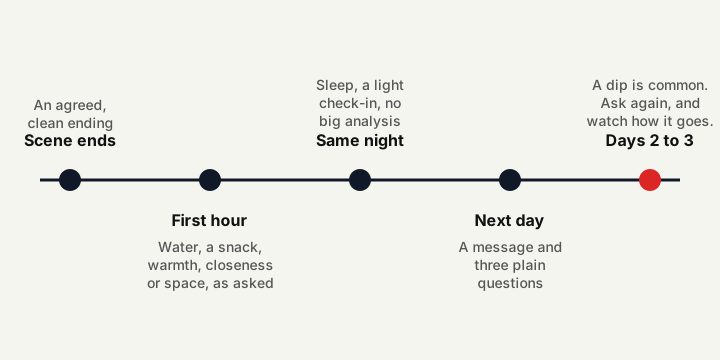
- End the scene cleanly with an agreed phrase or gesture, not by drifting off.
- Take care of the body first: warm, covered, comfortable, with water in reach.
- Ask what is wanted: "Closeness, space, or something else?" Both answers are fine.
- Keep it light. A simple "how are you feeling?" does more than a long debrief.
- Leave the heavy analysis for the next day and tidy up when you both feel steady.
People want different things, and the same person wants different things on different days. Some want cuddles, some want to be left alone for twenty minutes, some talk, some laugh. Ask during negotiation and ask again afterwards, because what you needed last time may not be what you need tonight.
Sub drop and top drop
Sub drop is a low mood that can follow a scene, often hours later and sometimes a day or two later. Top drop is the same experience on the other side, and it often comes as guilt or a worry: did I do too much? Typical signs are tearfulness, irritability, tiredness, feeling flat or a bit unreal, and a wish to withdraw.
I do not claim a single proven cause. Educators usually describe it as the come-down after strong feelings and adrenaline, mixed with the vulnerability of having let someone see you in an intense moment. What matters in practice is to know it is common, that it is not a sign you did something wrong or that your partner did, and that planning ahead keeps it smaller.
It is also worth asking whether the low mood points to something that actually happened in the scene. If a limit was crossed, a signal was missed or something felt wrong, that needs a proper conversation, not just a blanket. See safewords and consent.
The next-day check-in
Send a message or talk the next day, once things have settled. Keep it warm and ask rather than assume. Three questions are enough:
- How are you feeling today, in body and in mood?
- What worked for you last night, and what would you change?
- Is there anything you want off the list or done differently next time?
Another short check a couple of days later is a good habit, especially after something new or intense. If you are in different places, a message does the job. The point is that the other person knows you have not forgotten them.
Put aftercare into the negotiation
Aftercare belongs in the same conversation as limits and safewords. Settle these before the scene:
- What each of you tends to want afterwards, and what you do not.
- How long you will set aside, and who is responsible for the kit.
- What happens if one of you wants space, and how you will tell each other it is not rejection.
- When and how the next-day check-in happens, including when you live apart.
The yes/maybe/no list gets you most of the way: add "aftercare talk and cuddles" to your yes items and agree the details. How to run that conversation is in how to talk to a partner about kink.
When a low mood does not lift
A drop that fades within a day or two is common. If it lasts longer, deepens, or brings thoughts of harming yourself, treat it as a health matter, not as part of the scene. Talk to your doctor or a kink-aware therapist. This is general information, not medical advice. If you feel unsafe, contact your local emergency services or a crisis line in your country.
It may help to know that consensual kink is not a disorder in itself. ICD-11 counts a consensual interest as a disorder only with marked distress or a direct risk of injury or death (ICD-11 code 6D36). Feeling low afterwards is a separate matter, and one worth taking seriously. For how to read the numbers behind your own result, see BDSM test results explained.
FAQ
What is aftercare?
The physical and emotional care that follows a scene: water, warmth, closeness or space, and a gentle check on how both people feel. It is for both partners and helps the body and mind settle.
What is sub drop?
A low mood that can follow a scene, often hours or a day or two later. Signs include tearfulness, tiredness, irritability and feeling flat. Top drop is the same experience for the partner who led.
How long does sub drop last?
For many people it fades within a day or two. If it lasts longer, deepens or brings thoughts of self-harm, talk to a doctor or a kink-aware therapist. This is general information, not medical advice.
What should be in an aftercare kit?
Water, a snack, a blanket or robe, a warm drink and a quiet room, plus time with nothing booked afterwards. Set it within reach before the scene begins.
Should I check in the day after a scene?
Yes. A short message or call the next day, with questions about how you feel, what worked and what to change, helps both of you. Another check a couple of days later is a good habit.