BDSM test results explained: dom, sub, switch and every scale
Updated October 12, 2026 · 7-minute read · 7 sections
Dominant 78 %, submissive 71 %, switch 64 %: people send me BDSM test results like that and ask which one is "the real one". All three are. A result is a snapshot of how you answered 34 statements, and each number answers a narrower question than a label does.
Every part of a result can be checked by hand, because the BDSM test on this site uses fixed thresholds. They are all below.
A percentage is a share of your own answers
Every scale has two or three statements. Each answer is worth 0 to 4 points (Strongly disagree 0, Disagree 1, Neutral 2, Agree 3, Strongly agree 4). The scale score is your points divided by the most you could have scored on the items you answered:
Take the brat scale. You answer Strongly agree (4) and Agree (3): 7 ÷ 8 = 87.5, shown as 88 %. If you skip one item with "Not sure" and answer the other 4, it becomes 4 ÷ 4 = 100 %. Skipping changes the base, not just the total, so skip because you really are unsure, not to dodge a statement. A scale where you skipped everything shows a dash, never a zero.
Two things follow. First, 50 % is neutral, not "half kinky". A scale only counts as one of your top interests when it is strictly above 50. Second, the percentages are not a ranking against other people. They compare you with your own ceiling.
How the role line is decided
The dominant and submissive scores are not added up or averaged. The role line follows four rules, in this order:
- Take R, the larger of your dominant and submissive scores.
- If R is below 55, the role is Vanilla when your vanilla score is 60 or more, otherwise "No clear lean yet".
- If both scores are 55 or more and they differ by less than 20 points, the role is Switch.
- Otherwise the role is whichever of the two is larger.
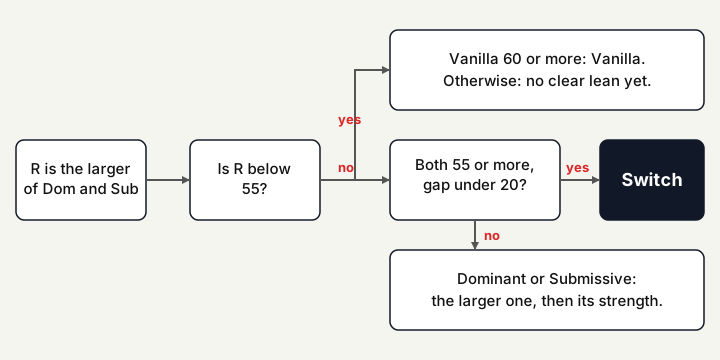
A worked example. Dominant items 4, 3, 3 give 10 ÷ 12 = 83.3 %. Submissive items 1, 2, 1 give 4 ÷ 12 = 33.3 %. Two switch statements answered Neutral (2 and 2) give 50 %. The switch score is the average of the lower role score and the direct switch answers: (33.3 + 50) ÷ 2 = 41.7, shown as 42 %. R is 83.3, which is at least 55, and the lower score is 33.3, which is under 55, so rules 2 and 3 do not fire. Result: Dominant, with a gap of 50 points.
The strength word describes the size of the winning score:
| Score | Word | What it usually looks like |
|---|---|---|
| 75 and above | Strong | You gravitate to this without being asked; it shapes what you look for. |
| 50 to 74 | Moderate | Appealing and worth a conversation, probably with some conditions attached. |
| 25 to 49 | Mild | Curiosity at most. Depends on the partner, the mood and the pace. |
| Under 25 | Low | Not your thing, and that is a perfectly good answer. |
Why dominant and submissive can both be high
People worry about this more than anything else. The two scales ask separate questions: do you like leading, and do you like being led? Nothing stops both answers from being yes. When both land at 55 or above within 20 points of each other, the test calls the role Switch.
I treat switch as its own identity, not as indecision. Some switches alternate with the same partner, some lead with one partner and follow with another, and some lean one way for a season. Because the switch score blends your lower role score with the direct "I would like to swap" answers, a pure dominant who never thinks about following gets a low switch number. That is the intended behaviour.
When the scores are close but one is under 55, for example dominant 80 and submissive 50, the role reads Dominant. The 50 is still real information. It tells you there is some curiosity on the other side, and it is worth talking about, just not worth a new label.
The scales in plain words
| Scale | A high score means | Pairs well with |
|---|---|---|
| Dominant | You enjoy leading, setting the pace and carrying the responsibility for how it goes. | Submissive |
| Submissive | You relax when a trusted partner leads and you follow. | Dominant |
| Switch | You like both sides and may swap with the partner or the mood. | Another switch, or a partner who enjoys flexibility |
| Sadist | You like giving intense sensations to a partner who asked for them. | Masochist |
| Masochist | Intense sensations can feel good to you, within limits you set. | Sadist |
| Rigger | You like the craft of restraining or tying a willing partner. | Rope bunny |
| Rope bunny | Being held still by someone you trust sounds appealing. | Rigger |
| Brat | You enjoy playful defiance and daring a partner to respond. | Brat tamer |
| Brat tamer | You enjoy calmly steering a cheeky partner back into line. | Brat |
| Primal | Chasing, wrestling and acting on instinct appeal to you. | Another primal player |
| Exhibitionist | Being watched or admired is part of the thrill. | Voyeur |
| Voyeur | You like to be the one watching and taking it in. | Exhibitionist |
| Role-player | Costumes, scripts and characters help you into the mood. | Another role-player |
| Experimentalist | You like trying new things and going through a list of options. | Anyone with a curious streak |
| Sensualist | Slow touch, textures and heightened senses appeal to you most. | Almost anyone, which is why it is a good meeting point |
| Vanilla | You prefer gentle, familiar intimacy without power play. | A partner who values the same |
Note that a role and an interest are separate. A submissive can score high as a rigger, and a dominant can score high as a masochist. If that looks contradictory, it is not: roles describe who leads, interests describe what you enjoy.
Why your numbers move between takes
Expect your numbers to move when you retake the test. Mood, stress, the partner you have in mind, a film you just watched and the day of the week all leak into self-report. I suggest taking it twice, a few weeks apart. What stays put is far more telling than what moves.
Two notes the test can give you
- No clear lean yet. Both role scores are under 55, or the result sits at 50 everywhere because most answers were Neutral. It is not a failed test. It usually means the statements did not land yet, and the interest bars may still tell you something.
- Agreed with almost everything. When at least 90 % of your answers are Agree or Strongly agree, every scale rises together and the profile cannot separate your interests. Retake it and decide which statements are a real yes and which are a polite one.
The test also adds a note when you answered fewer than 24 of the 34 statements, because short answers swing the percentages.
What a result is not
It is a self-reflection quiz for adults, not a diagnosis or a clinical assessment. ICD-11 removed fetishism and sadomasochism as categories, and it counts a consensual or solitary interest as a disorder only with marked distress or a direct risk of injury or death (ICD-11 code 6D36). One large study of practitioners and a control group also found they scored lower on neuroticism and higher on well-being, and its authors describe BDSM as recreational leisure, not psychopathology (Wismeijer and van Assen).
A high score is never an obligation, and a match is never consent. Next steps are in how to talk to a partner about kink, safewords and consent and aftercare and sub drop.
FAQ
Is the BDSM test accurate?
It is accurate about one thing: how you answered 34 statements today. It cannot measure who you are, and results shift with mood, so treat it as a conversation starter and retake it after a few weeks.
Is it normal to score high on both dominant and submissive?
Yes. The scales ask separate questions about leading and being led. If both are 55 or more and within 20 points, the test reads the role as Switch.
What does a switch score mean?
Switch blends your lower role score with your direct answers about swapping roles. A high number means you enjoy both sides, not that you cannot decide.
Does a high interest score mean I should try it?
No. A score describes appeal, not a plan. Anything you try should be negotiated first, with limits and a safeword agreed in advance.
What does No clear lean yet mean?
Both dominant and submissive are below 55, and vanilla is below 60. Often it comes from many Neutral answers. Retake it later or look at the interest bars instead.